The Microbrewed Beer of the Month Club

Past Newsletters

Vol. 4 No. 9

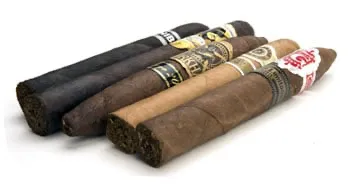
Featured Cigar Dimensions

Brand Name: Shape Size
A. Mayorga Robusto Robusto 4 3/4 x 50
B. Mayorga Corona Corona 5 1/2 x 44
C. Mayorga Toro Toro 6 x 50
D. Big Butt Robusto Robusto 4 3/4 x 54
E. Big Butt Don Gordo Toro 6 x 54

Featured Cigars

The Mayorga Cigars

Prepare yourself for a treat. The Mayorga Cigar line was created by Master blender, Carlos Mayorga when he and his brother, Martin, founded the relatively small Cigar manufacturing company less than five years ago. The Nicaraguan-born brothers oversee operations at the plantation which is located in Esteli, in the famed Jalapa Valley just fours hours north of Nicaragua’s capitol, Managua. The plantation employs 60 rollers and manufactures only 300,000 cigars per month. The cigar line was introduced to the United States only two years ago when it was one of only 12 cigars offered for sale at each of the five Grand Havana Rooms, one of the more highly exclusive cigar clubs in the country.

As our panel was thrilled with the entire product line, you’ll get to sample all but one of the cigars manufactured by the Mayorga brothers. In addition to a Corona, Toro and Robusto, the line also includes a Churchill. Extended aging in Spanish cedar-lined rooms provides a perfect balance of flavor and consistency in this complex cigar line. The Sumatran Seed Indonesian wrapper gives this line a unique slightly sweet spiciness. For more information about the product line contact its exclusive U.S. distributor, Green Mountain Unlimited, directly at (888)-MAYORGA or via their website: http://greenmountain.com. Email: sales@greenmountain.com.

Corona

Binder: Cuban Seed Nicaraguan
Filler: Cuban Seed Nicaraguan
Wrapper: Sumatran Seed Indonesian
Strength (Mild 1, Full 10): 5
Panel Rating: 90

Notes from the Panel:

This cigar’s dark, rich, oily wrapper commands your attention immediately. We found it to be expertly rolled, quite firm with no soft spots. Note a near-perfect draw and extended, consistent white ash demonstrating that no young tobacco was used to produce this cigar. It was definitely properly aged. We found it to be a very relaxing smoke with overtones of complex spiced fruit and perhaps nutmeg. It’s a medium-bodied smoke with a creamy, rich body. Consider this cigar before dinner with either your favorite single malt scotch or brandy.

Robusto

Binder: Cuban Seed Nicaraguan
Filler: Cuban Seed Nicaraguan
Wrapper: Sumatran Seed Indonesian
Strength (Mild 1, Full 10): 6
Panel Rating: 91

Notes from the Panel:

They get better. Another professionally constructed cigar. Again, very firm, nice to hold prior to smoking and an exceptional draw that forces you to pull on it just a little before it heats up. You’ll note a little more heat surprisingly than the corona and even more spiciness to the flavor profile. It burned perfectly straight and offered plenty of smoke for the palate. The flavor is simple, medium in body, a unique spiciness with sweet, creamy undertones. Try this one with Ron Anejo’s Pampero Anivesario Rum.

Toro

Binder: Cuban Seed Nicaraguan
Filler: Cuban Seed Nicaraguan
Wrapper: Sumatran Seed Indonesian
Strength (Mild 1, Full 10): 6
Panel Rating: 92

Notes from the Panel:

Our favorite of the three, the Toro was a cooler and slower smoke, which really allowed us to appreciate this cigar line’s exceptional flavor. Look for a well-constructed smoke, with the same sweet spicy, creamy flavor profile. We picked up a bit of cedar woodiness as well in the Toro. Note a wonderfully scented aroma that’s not too heavy, but most definitely pleasant. Consider pairing this fine cigar with a smoky single malt scotch such as Lag Vulin.

The Big Butt Cigars

Don Carlos Santiago, known by friends and family as "Don Gordo", hand-rolled perhaps the most legendary cigars in pre-revolution Cuba. He produced the very fattest of the Cuban cigars, called "Big Butts" by his loyal customers. Only the wealthy and influential connoisseurs in high-flying Havana enjoyed these rare masterpieces. During the Communist revolution, the Santiago farm and factory were seized and burned to the ground. Don Gordo escaped to The Dominican in the hold of a shrimp boat, paying for his exodus with his last two boxes of Big Butts. He lived in The Dominican and worked as a master roller until his death in 1994.

After Don Gordo's death, a single trunk of his personal effects was forwarded to his extended family in the United States. The trunk contained his personal notebooks describing the various tobacco blends used in his cigars, some seeds, and even the deed to the family farm in Cuba. The family now has all the records and resources necessary to re-establish the farm, once Cuba is liberated. But why wait? Eager to fulfill Don Gordo’s wish to re-establish his name in the world of fine tobacco, founder and grandson of Don Gordo, Joe Seither, resurrected the Big Butt Cigar Co. using full-flavored Nicaraguan and Indonesian tobacco blends. We know you will enjoy these medium-bodied, unusually large ring gauge cigars. For more information about the Big Butt Cigar Company, call 800-363-3995 or email Joe directly with your feedback at joe@bigbutt.com.

Robusto

Binder: Nicaraguan
Filler: Nicaraguan
Wrapper: Indonesia
Strength (Mild 1, Full 10): 5
Panel Rating: 87

Notes from the Panel:

We found Don Gordo’s robusto to be a medium-bodied, properly-aged, and well-constructed large ring gauge smoke. Look for the cigar to start with some floral tones with earthy notes evident. A cedar woodiness comes out as you get into this cigar. Some resiney character from the stronger Jalapa leaf is apparent as well. Consider smoking it with a heavy ale or brandy.

Toro

Binder: Nicaraguan
Filler: Nicaraguan Wrapper: Indonesia
Strength (Mild 1, Full 10): 5
Panel Rating: 89

Notes from the Panel:

Don’t let the light-hearted name fool you, Big Butt’s Toro is a serious smoke. Aesthetically, a very handsome cigar, firmly rolled with a slightly oily Indonesian wrapper. Look for a well-constructed, medium-bodied cigar with hints of spiciness and rich tobacco flavor. Note a smooth, even draw and a consistent burn. The mild-to-medium spiciness of this cigar will nicely complement a dry red wine.

Wrapper Color and Flavor

Perhaps the cigar tyro's most persistent misapprehension is that color is an index of the tobacco's body - not surprisingly, since a rich, dark-brown leaf seems to suggest greater strength than a light-colored one. It is perfectly true that many cigars of dark leaf are full-bodied; but, strictly speaking, color is an indication of flavor, the darker tobaccos almost invariably being fuller-flavored than the lighter ones. Flavor, like body and aroma, derives partly from the growing leaf - that is, from the basic characteristics of the individual parent plant, from the part of the plant from which the leaf was taken, and whether the leaf was picked at the moment of optimum development or earlier or later - and also from the duration and intensity of the fermentations. The reason why one can be confident that deep-colored leaf is full-flavored is that long fermentations, which increase the intensity of flavor, invariably produce a dark leaf.

In the complex blend of flavors contributed by filler, binder, and wrapper, that of the wrapper tends to be dominant. The experienced smoker of Havana, of course, knows exactly what he is getting through long familiarity with particular brands: the flavor of his present consignment of, say, Bolivar, Hoyo de Monterrey, Montecristo, Romeo y Julieta, or whatever, duplicates, down to the finest inflexions, that of his previous consignment and will in turn be as exactly matched by next year's. To someone trying Havanas for the first time, one of the earliest lessons in what should develop into a liberal education is that of learning how the range of color tones of Havana wrappers can be used to infer the flavor of the cigars as a whole. Cigars are classified, according to the color of the wrappers, into the following broad groups.

Lightest of all is the double claro, or claro-claro, which has an almost blond wrapper, although the filler is commonly of a somewhat darker color. The lightness of color is achieved by harvesting the leaf before it is fully mature and then drying it rapidly with the heat from a wood fire lit outside the barn, the hot air being passed through flues; a rarer and more costly double claro wrapper, known as capa candela, was once dried, as its name suggests, by the heat of candles. The double claro wrapper also undergoes a comparatively short and mild series of fermentations lasting a total period of less than nine months. As one would expect, the double claro has the mildest flavor of all the standard-range Havanas; it is also light in body as a rule, so that the total smoking experience is one of great, though subtle, reticence.

Somewhat darker is the claro, in which the very light brown of the wrapper leaf has an unmistakable tinge of green. For this reason, such cigars are commonly called 'fresh' - a misleading term, of course, since the claro wrapper (like every other type of leaf) undergoes curing and fermentation. Like the double claro wrapper, the claro comes from naturally pale leaf that was picked before it had fully ripened. It undergoes about 48 days of natural drying in the barn. Again like the double claro its light color and intrinsically mild flavor are retained by means of a sequence of relatively short fermentations totaling not more than 12 months. The claro represents the most significant growth area in the world- wide cigar market - the trend in every type of tobacco being toward mildness. The Havana claro is justly celebrated for the delicacy of its aroma, and is responsible in large measure for the significant increase in the number of women who now enjoy smoking cigars.

The next two groups, colorado claro, with light-brown wrapper, and colorado, which has a brown wrapper with a characteristic reddish tinge, are both highly aromatic, though slightly less so than the two previously mentioned groups. However, they offer a progressive intensification of flavor, though even the colorado, the fuller flavor of the two, is still strictly speaking a mild cigar.

Next come colorado maduro and the maduro. The first has a mid-brown wrapper and is of medium flavor and body. The maduro (the word means 'mature') has a dark-brown wrapper, and its filler leaf is often even darker. Although relatively low on aroma, the maduro has a rich, full flavor and is usually medium to full-bodied. It is, in short, the classic leaf for most experienced cigar lovers looking for the richest and most satisfying experience in Havanas.

Darkest of all, the oscuro has a virtually black wrapper and filler, very full flavor, and is often exceptionally full-bodied. It is grown in the open field, not under shade. For most modern European tastes the oscuro's flavor and body are too intrusive, and its aroma too negligible, to permit of the highest smoking pleasure, though it has plenty of devoted followers in Central and South America.

While these color categories offer a general guide to leaf types and flavors, it is important to stress that it is only a guide. Such is the diversity of Havana leaf that there is a considerable range of colors and flavors within each category. Remember, too, that although the flavor increases, and the aroma diminishes, with progressively darker tobaccos, color is by no means an infallible guide to body, or strength. This is also a convenient moment to expose, once and for all, a notorious fallacy; namely, that the darker the leaf the higher the concentration of nicotine. The two factors are quite unrelated, and in some cases the darker tobaccos contain less nicotine than light ones. In any event, Havana leaf has a significantly lower concentration of nicotine than cigarette tobaccos.

Among Havanas imported into the United Kingdom, the standard color range available is from claro to maduro, although the latter is only available to special order. You will find that the color type is indicated on the side or bottom of every cedar box according to the following code; dc (double claro), ci (claro), cc (colorado claro), c (colorado), cm (colorado maduro), m (maduro); the absence of a code letter on some brands generally means that they are claro.

Source: From the Book of the Havana Cigar, Oebis Publishing, London 1983

Cigar Wrapper Characteristics

Color Abbrev. Description
Double Claro "DC" Also known as "English Market selection" (AMS) or "Candela," this is a green wrapper. Once popular, it is rarely found today.
Claro "CI" This is a very light tan color, almost beige in shade; usually from Connecticut.
Colorado Claro "CC" A medium brown found on many Cigars, this category covers many descriptions. The most popular are "Natural" or "English Market Selection." (EMS) Tobaccos in this shade are grown in many varied countries.
Colorado "C" This shade is instantly recognizable by the obvious reddish tint.
Colorado Maduro "CM" Darker than Colorado in shade, this color is often associated with African tobacco, such as wrappers from Cameroon, or with Havana Seed tobacco grown in Honduras.
Maduro "M" Very dark brown or black; this category also includes the deep black "Oscuro" shade. Tobacco for Maduro wrappers is often grown in Connecticut, Mexico, Nicaragua and Brazil.

Source: Perelman’s "Pocket Cyclopedia of Cigars", 1997 ed.

Calibrating a Hygrometer

Here's a fun, kitchen-table project: checking out your hygrometer's accuracy. Half-fill a shot-glass with table salt and add enough water to make a paste. Put shot-glass and hygrometer in a wide-mouth jar, and seal airtight. Ziploc™ bags can have pinholes in them, so don't use them. After six hours, the actual humidity in the jar is 75%. If your hygrometer reads other than 75% in the jar, you must correct all subsequent readings by this difference. Example: if the hygrometer reads 73% in the jar, it is reading 2% low. Thus, it will always read 2% less than the actual RH in your humidor.

Cigar Comeback Is On in Private Clubs

Several years ago, the private club at 16 Gramery Park in New York City known simply as, "The Players", stopped selling cigars. "We just don't get any call for them anymore," said a somewhat baffled bartender. Times have changed at The Players, because cigars are very much at home again in the house that once belonged to the great actor Edwin Booth, one of the most illustrious Players of all time. Meanwhile, many other private clubs across the country are also experiencing upward trends in requests for cigars with Macanudo and Partagas brands clearly leading the way.

Last year in New York City, the largest increases were at the New York Yacht Club, where requests for cigars doubled, and at the University Club and the Metropolitan Club, which reported double-digit increases. As for two of the most famous Ivy League establishments in Manhattan, the Harvard Club recently emulated the arch-rival Yale Club, which has been known to host an affair or two for cigar smokers, by holding a cigar night of its own for some 70 delighted smokers. Cigars are doing equally well in some of the more renowned clubs on both coasts. Club 19, the 19th-hole oasis at Pebble Beach Golf Club in California, does a very brisk business. And the Doral Golf Club & Spa in Miami is selling "a lot more" cigars than ever before.

Elsewhere around the country and beyond, the number of cigar clubs increased during the past few years to the point where, in 1994, an informal organization called the International Association of Cigar Clubs was formed to keep track of them. In the words of Founder & Chief Smoking Officer Robert Langsam, IACC is a "for-the-smoker, by-the-smoker network" with only one motive: to generate good will among cigar lovers. To do so, IACC lets cigar lovers know where their peers are and provides assistance and support for existing clubs as well as clubs yet to be originated.

How Small Can a Cigar Get?

Making a small cigar is hardly a small undertaking. Typically, a small cigar tends to smoke hot. To make the 3 ¾" x 24 ring-gauge Macanudo Miniature, the Macanudo cigar makers developed a unique way to make a small cigar. To begin with, the same tobaccos and Connecticut Shade wrappers that are used in making the large Macanudo cigars are used in making the Miniatures. And significantly, the aging process for the blend as well as the wrappers takes at least two years, just as it does for large Macanudo cigars. The result is a breakthrough brand in the small-cigar category, because Macanudo Miniatures are the only American-style small cigars that are made with all-natural tobacco. (American-style refers to a small cigar that's supple rather than brittle like European-style baked cigars).

Cigar Stings

Five Californian-based cigar smugglers were victims of a government sting operation which ended with their arrests. "Operation Smoke Ring", the first large-scale government operation of its kind, got rolling in November of 1996 when the Feds confiscated 900 Cuban cigars from the home of a Sacramento businessman. In exchange for having the charges against him dropped, the man pointed Customs officials towards ringleader Joseph Hybl. Camped outside Hybl’s house on an early morning last April, Customs officials moved ahead when they saw smoke billowing from the chimney. Upon entering the house they witnessed Hybl and girlfriend Julie Ann Chatard attempting to burn 100 boxes of Havanas in the fireplace. Three other colleagues were arrested during the succeeding 24 hours. The defendants are pleading not guilty on the grounds that the Trading with the Enemy Act they’ve violated is unconstitutional in time of peace. Hybl allegedly obtained the cigars at shops and factories in Cuba, smuggled them into the United States and distributed the goods to collectors, bars, clubs, and restaurants, mostly in CA but reaching as far as New York. Hybl and company were apparently living quite large for awhile; their Cuban booty was commanding two and three times its face value on the black market.

Made in the Shade

New England-based tobacco growers are salivating at the early indications of expected yield from the current crop of Connecticut shade, the most expensive cigar tobacco in the U.S. Grown in the Connecticut River Valley, shade tobacco is the preferred wrapper for many of the big dogs of the cigar world, including Davidoff and Macanudo. After four straight years of increases in acreage—including an increase of 25 to 35 percent this season—growers report they’re getting about 10 percent more per pound. "It’s probably the biggest I’ve ever seen it," reports Steve Garcia, a manager at Windsor Shade Tobacco in Connecticut. "The market snuck up on us, and it’s hard to tell when it will level off. We’re optimistic it will continue." The only thing holding the Connecticut growers back is available land. The tobacco is stored in curing barns while it dries, and the high price of real estate and labor required to build the barns in Connecticut, as compared to places like Honduras or the Dominican Republic, makes it difficult for growers to produce as many barns as the demand requires. Nonetheless, it’s not a bad predicament for them to be in.

For Members Only

Give Your Friends FREE Beer, Wine, Cheese, Chocolate, Cigars & Flowers!
Through our Customer Appreciation Program

Your name has real value to your friends, co-workers, and family members! Every time a friend, family member, or anyone else you know joins any one of our clubs, [or gives a gift] for 3 months or longer, we'll give them 50% off of their first month, but only when they mention your name. And we'll also give you 50% off your next month too which can either be applied towards your current membership or you can try one of our other Clubs out! (We can add one more month to your order at 50% off for prepaid memberships!)

The Fine Print: Members giving gift memberships do not qualify for referral credits and you can't give yourself a gift to qualify! This Program is mutually exclusive of any other promotions.

Membership Q & A

Note: Please do not use our email address to make any account related information changes such as address or billing changes, membership extensions, or terminations. To ensure timely processing of your request, please call us at 800-625-8238.

Q: What should I do if I'm moving or want to extend my membership?
A: Please call us prior to the 10 th of the month to make all account related information changes such as address changes, membership extensions & terminations, or gift accounts desiring to continue their memberships. Address changes made after that time may require a $4.00 re-shipping charge.

Q: How will the charge appear on my credit card statement:
A: Your credit card statement will reflect our Incorporated business name, C&H Clubs, U.S.A., Inc., NOT The Cigar Society.

Q: What happens if my shipment is damaged?
A: If you shipment arrives damaged, please call us immediately toll free at 1-800-625-8238 and report the incident for a prompt resolution.

Q: What happens if my credit card is declined?
A: We will attempt to reprocess the card and if it does not clear on the 2nd attempt, you’ll receive a courtesy notice asking for an alternative payment method and your order will be temporarily suspended until we hear from you. As we incur a $ 2.00 re-processing fee each time your card does not clear, that charge is passed on to you.

Q: What happens if I join under a special incentive program and don’t stay a member for the entire term committed?
A: Not a problem. Although we want to do everything we can to keep you as a member, we will allow you to cancel your subscription early, however, you will be responsible to pay for the item which was given to you as part of the promotion.

C&H Internationals Logo Since 1994
Since 1994
Join our Club
Gift Memberships
Renewals
Reorders
Home
Cigar of the Month Club Info
Current Cigar Selections
Past Selections
Q&A
Testimonials
Other Gourmet Clubs
Corporate Gifts
Wedding Gifts
Industry Resouces
Events
Print a Gift Card
Send a Virtual Stogie
Refer a Friend
Send a Hint
E-Promos
Contact Us
Link to Us

1 - 800 - 625 - 8238
(Outside US call: 949-206-1904)
P.O. Box 1627, Lake Forest, CA 92609